Executive Summary
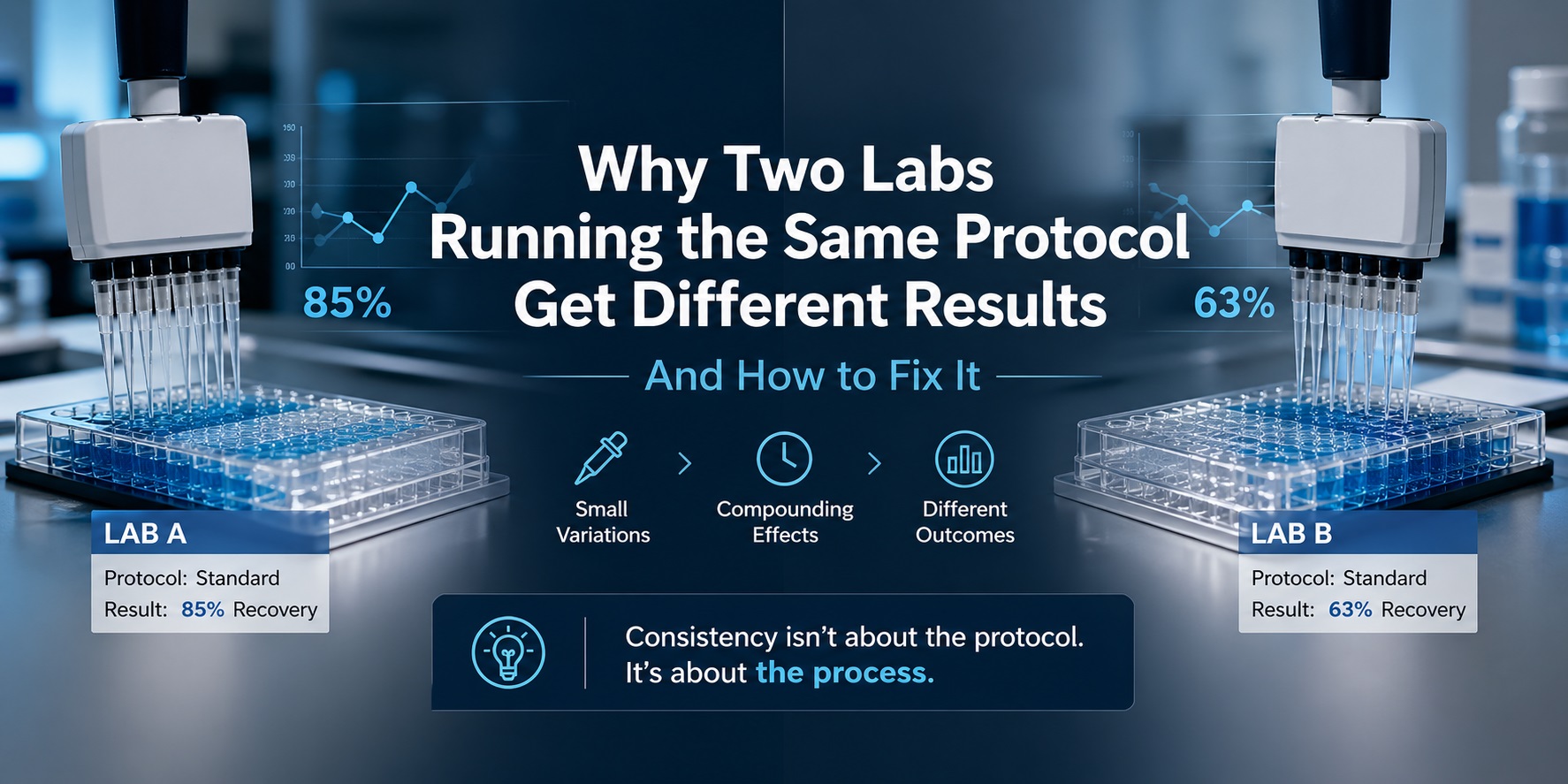
In theory, standardized protocols should produce standardized results. Yet across biotech, life sciences, and pharmaceutical labs, the same assay run in two different environments often yields different outcomes.
This inconsistency is rarely caused by flawed science. More often, it comes from small variations in execution—sample handling, liquid transfer, timing, environmental conditions, and workflow design.
Regulatory frameworks from organizations like the Food and Drug Administration (FDA) and Centers for Disease Control and Prevention (CDC) emphasize that quality must extend across the full testing process—not just the analytical step. Even minor deviations early in the workflow can compound into measurable differences in final results.
Understanding where variability originates is the first step toward eliminating it.
The Expectation vs. Reality Gap
Protocols are written to control variables. But in real lab environments, variables still exist:
- People execute steps slightly differently
- Equipment behaves differently over time
- Samples arrive in inconsistent condition
- Timing varies between steps
Even when every step is followed “correctly,” these small differences create drift.
The result:
→ inconsistent recoveries
→ variable signal strength
→ reduced reproducibility
Where Variability Actually Comes From
1. Sample Handling Differences
Before any assay begins, variability may already be introduced.
- Inconsistent labeling or handling
- Temperature fluctuations during transport
- Delays between collection and processing
The Centers for Disease Control and Prevention emphasizes that proper specimen collection and handling are critical because compromised samples cannot produce reliable results.
2. Liquid Handling Variability
Pipetting is often treated as a “solved” problem—but it isn’t.
Small inconsistencies in:
- technique
- calibration
- liquid properties
can introduce measurable error, especially across multi-step workflows.
Guidance from the National Institute of Standards and Technology (NIST) highlights that volumetric accuracy depends on proper technique, calibration, and handling—not just equipment capability.
3. Workflow Timing and Human Factors
Even slight differences in timing can impact outcomes:
- dwell times during extraction
- delays between steps
- batching vs. continuous processing
At small scale, these differences are minimal. At higher throughput, they compound.
4. Equipment and Setup Variability
Two labs may use:
- different configurations
- different consumables
- different maintenance schedules
Even with identical protocols, these differences affect consistency.
5. Data Handling and Interpretation
Variability doesn’t stop at the bench.
Manual data entry, inconsistent reporting formats, and missing metadata can introduce errors or obscure trends.
The Food and Drug Administration defines data integrity as completeness, consistency, and accuracy—highlighting the importance of traceability across the full process.
Why Small Differences Become Big Problems
Individually, these factors seem minor. Together, they create:
- drift across plates
- inconsistent recovery rates
- higher rework and reruns
- reduced confidence in results
This is why two labs can follow the same protocol—and still produce different data.
What Better Looks Like
Reducing variability isn’t about adding more steps.
It’s about designing workflows that are:
- consistent by default
- less dependent on individual technique
- easier to execute correctly every time
Key improvements include:
- standardizing sample handling procedures
- reducing manual transfers and handoffs
- implementing repeatable liquid handling processes
- improving traceability across steps
When variability is controlled at the system level, results become more predictable—even at scale.
A Shift in Thinking
Most labs focus on optimizing individual steps.
But consistency doesn’t come from perfect steps.
It comes from how those steps connect.
The labs that achieve reliable, repeatable outcomes aren’t necessarily using more advanced tools—they’re operating within systems designed to minimize variation.
Conclusion
Two labs running the same protocol should get the same result.
When they don’t, the issue is rarely the protocol itself—it’s the execution environment surrounding it.
By identifying where variability enters the workflow and reducing dependence on manual precision, labs can significantly improve consistency, throughput, and confidence in their data.
FAQ
Why do identical lab protocols produce different results?
Because real-world variables—sample handling, liquid transfer, timing, and equipment differences—introduce small inconsistencies that compound over time.
What is the biggest source of variability in lab workflows?
It’s typically not a single factor, but a combination of sample handling, pipetting variation, and workflow timing differences.
How can labs improve reproducibility?
By standardizing processes, reducing manual intervention, and improving consistency across the entire workflow—not just the analytical step.
Does automation eliminate variability?
Not entirely. Automation reduces human variability, but systems still need proper design, calibration, and monitoring to ensure consistent results.
Why is data integrity important in lab workflows?
Accurate, complete, and traceable data ensures results can be trusted, reproduced, and validated—especially in regulated environments.
Sources & References
- Centers for Disease Control and Prevention — Laboratory Quality Management Systems
- Food and Drug Administration — Data Integrity and Compliance Guidance
- National Institute of Standards and Technology — Volumetric Measurement and Calibration Standards